


The intellectual landscape of human history shifted forever when theoretical physicist Albert Einstein published groundbreaking papers that fundamentally altered our understanding of space, time, and gravity. Long before becoming a universally recognized symbol of supreme intelligence with wild hair and a thoughtful demeanor, a quiet patent clerk in Bern was quietly revolutionizing scientific thought. Academic institutions and global scientific communities quickly became captivated by his extraordinary mind, elegant mathematical equations, and profound philosophical insights into the universe. People everywhere grew fascinated by the unique worldview, pacifist advocacy, and remarkable life journey of Albert Einstein. This rare combination of visionary scientific genius and deep humanitarian compassion redefined what it means to be a modern intellectual icon, leaving an eternal mark on human civilization forever.
Quick Bio Section
- Full Name: Albert Einstein
- Date of Birth: March 14, 1879
- Place of Birth: Ulm, Kingdom of Württemberg, German Empire
- Occupations: Theoretical physicist, philosopher, professor
- Spouse: Mileva Marić (m. 1903–1919), Elsa Löwenthal (m. 1919–1933)
Early Years of Curiosity and Self-Directed Learning in Germany and Switzerland
Growing up in a secular Jewish family in Munich, the young thinker displayed an early fascination with geometry, classical music, and the mysteries of the natural world. Relocating to Switzerland during teenage years allowed completion of secondary education in Aarau within a progressive, supportive academic environment. Enrolling at the prestigious Federal Polytechnic School in Zurich provided rigorous training in physics and mathematics, though unconventional study habits occasionally frustrated professors. Albert Einstein preferred independent exploration of advanced scientific literature over rigid classroom memorization. These formative academic years established a fearless habit of questioning established scientific dogmas that would eventually spark a profound global scientific revolution.
The Miraculous Year of 1905 and Special Relativity Breakthroughs
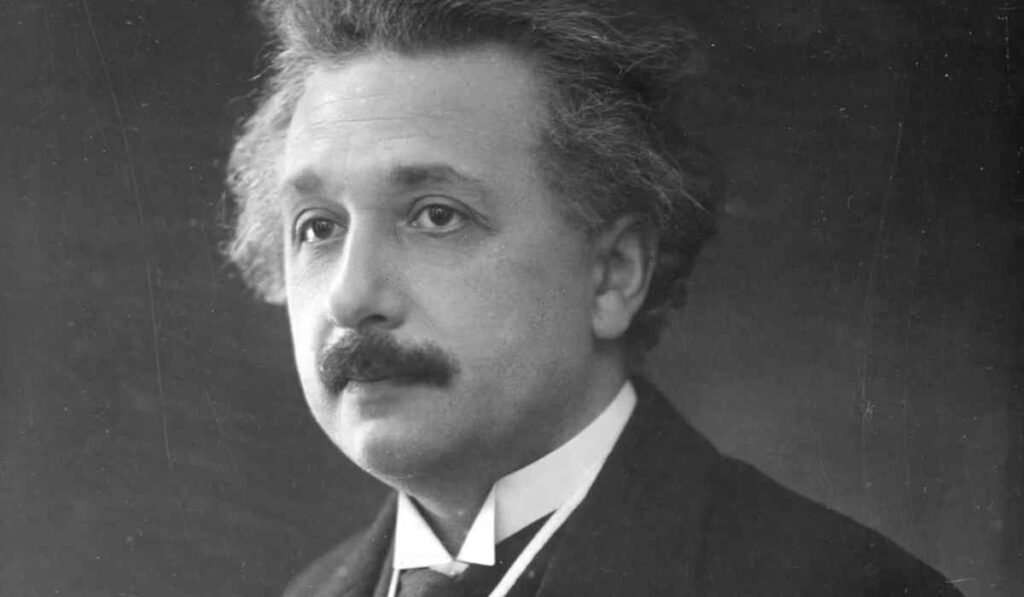
Working quietly as a technical assistant at the Swiss Patent Office in Bern provided unexpected mental freedom to contemplate deep theoretical physics problems. The year 1905, often called the annus mirabilis or miraculous year, witnessed the publication of four groundbreaking research papers in an elite German physics journal. These revolutionary publications explained the photoelectric effect, Brownian motion, and introduced the revolutionary theory of special relativity to the world. Albert Einstein demonstrated that space and time are not absolute but relative to the observer’s motion, forever altering classical Newtonian mechanics. This staggering outburst of intellectual creativity instantly established an unknown patent clerk among the world’s elite scientific minds.
Formulating General Relativity and the Curvature of Spacetime
Expanding upon special relativity over the next decade led to the formulation of general relativity, describing gravity not as a force but as spacetime curvature. Mathematical calculations suggested that massive cosmic objects warp the fabric of space and time around them, bending starlight in predictable ways. Testing this audacious theory during a 1919 solar eclipse brought sensational international media attention and validated the revolutionary physics predictions. Albert Einstein achieved global celebrity status overnight as newspapers heralded a monumental shift in human understanding. This crowning intellectual achievement cemented a permanent legacy as one of the greatest theoretical physicists who ever lived.
Winning the Nobel Prize in Physics and Global Academic Recognition

International scientific acclaim culminated when the prestigious 1921 Nobel Prize in Physics was awarded, specifically citing foundational contributions to theoretical physics and the photoelectric effect. Although general relativity remained intensely debated by some traditional scholars, the undeniable impact of quantum theory principles could no longer be ignored. Traveling extensively across Europe, Asia, and the Americas allowed Albert Einstein to deliver public lectures and meet leading international intellectuals, artists, and political figures. Academic institutions vied fiercely for research affiliations and professorship honors. These global travels showcased a humble, unassuming personality that charmed everyone fortunate enough to cross paths with a towering scientific intellect.
Fleeing Nazi Persecution and Finding Sanctuary at Princeton
Rising political hostility and the dark rise of the Nazi regime in Germany during the early 1930s forced a permanent departure from European academic life. Accepting a prestigious research position at the Institute for Advanced Study in Princeton, New Jersey, provided a safe intellectual sanctuary. Albert Einstein embraced American life while continuing theoretical research aimed at discovering a unified field theory of physics. Colleagues and students at Princeton revered the gentle professor who could often be seen walking on campus deep in mathematical thought. This American chapter offered stability, academic freedom, and a quiet haven to pursue lifelong scientific passions until the end of days.
Advocating for Pacifism and Global Nuclear Non-Proliferation

Deeply committed to peace and international cooperation, a lifelong stance against military aggression and nationalism guided extensive sociopolitical activism worldwide. Although a famous 1939 warning letter signed and sent to President Franklin Roosevelt inadvertently initiated atomic bomb research, lifelong pacifist beliefs remained unshakeable. Following the devastating end of the Second World War, Albert Einstein campaigned tirelessly for nuclear disarmament and global governance. Warning humanity about the catastrophic dangers of atomic warfare became a moral obligation. This passionate humanitarian advocacy proved that scientific genius carried profound ethical responsibilities toward the preservation of human civilization.
Exploring Unified Field Theories and Philosophical Musings
Dedication to theoretical physics never waned during later decades, as intense focus shifted toward formulating a single elegant equation explaining all universal forces. While younger generations of physicists embraced quantum mechanics and probabilistic uncertainty, Albert Einstein remained skeptical, famously remarking that God does not play dice with the universe. Countless hours spent at Princeton desks attempting to unify gravity and electromagnetism yielded few immediate breakthroughs but inspired future generations of theoretical thinkers. Beyond physics, philosophical essays examining religion, education, and human rights offered deep wisdom. These thoughtful writings revealed a rich internal landscape defined by wonder, humility, and fierce intellectual independence.
Cultivating a Lifelong Passion for Classical Music and the Violin
Balancing intense mathematical calculations with artistic expression found joyful harmony through a lifelong devotion to playing the violin. Often referred to affectionately as Lina, the beloved violin accompanied travel bags everywhere, providing emotional solace and creative inspiration during difficult research blocks. Performing chamber music with fellow academics and professional musicians allowed Albert Einstein to express emotions beyond the reach of scientific equations. Classical compositions by Mozart and Bach offered profound mental clarity whenever complex physics problems reached dead ends. This harmonious blend of science and art highlighted a wonderfully multifaceted soul who appreciated beauty in all its forms.
Shaping Modern Technology Through Pioneering Quantum Insights
Although theoretical research often seemed abstract, everyday modern life relies heavily on foundational technological applications derived from original physics discoveries. Principles explaining the photoelectric effect laid crucial groundwork for the development of modern photovoltaic solar cells, digital cameras, and photoelectric sensors. Laser technology, semiconductor devices, and global positioning satellite navigation systems all depend on adjustments predicted by relativity theories. Albert Einstein never lived to witness the smartphone revolution or renewable energy boom, yet foundational insights quietly power contemporary global infrastructure. This enduring practical impact proves that pure theoretical inquiry forms the bedrock of modern technological progress.
Mentoring Future Generations of Brilliant Scientific Minds
Supporting young researchers, university students, and struggling academic refugees became a deeply meaningful personal commitment throughout administrative and teaching years. Generous letters of recommendation and patient mentorship sessions provided vital career lifelines for countless aspiring scientists escaping European turmoil. Albert Einstein listened attentively to unconventional ideas, encouraging youthful curiosity without judgment or academic arrogance. Princeton offices and home porches frequently hosted lively discussions with tomorrow’s brightest intellectual stars. This nurturing approach to education ensured that scientific inquiry would continue thriving through passionate, open-minded successors worldwide.
Decoding the Mysteries of Time Dilation and Space Travel
Profound theoretical breakthroughs revealed that time is not a fixed universal clock but an elastic dimension dependent upon velocity and gravitational fields. Mathematical formulas demonstrated that clocks tick slower as objects approach the speed of light or experience intense gravitational pulls. These mind-bending concepts transformed science fiction speculation into rigorous physical reality, inspiring generations of astronomers and aerospace engineers. Albert Einstein provided the conceptual framework necessary for understanding black holes, gravitational waves, and expanding cosmic universes. Contemplating these vast cosmic scales instilled a profound sense of humility regarding humanity’s tiny place within the grand cosmos.
Inspiring Popular Culture and the Archetype of the Genius
Transcending academic boundaries, the iconic appearance, eccentric hairstyle, and gentle demeanor transformed Albert Einstein into a permanent symbol of supreme human intelligence. Photographs capturing playful tongue-out expressions or deep contemplation became globally recognized cultural memes replicated across media platforms. Countless books, biographical films, theatrical plays, and educational curricula celebrate an extraordinary life and career. Pop culture embraced the friendly professor as the ultimate personification of creative brilliance and intellectual curiosity. This widespread cultural osmosis ensured that complex theoretical physics concepts became accessible and fascinating to ordinary people everywhere.
Fostering Deep Friendships with Global Intellectual Icons
Surrounding a private life with brilliant contemporaries, artists, writers, and political leaders fostered a stimulating intellectual exchange across diverse disciplines. Deep mutual admiration connected Albert Einstein with literary giants like Thomas Mann, fellow scientists like Niels Bohr and Marie Curie, and civil rights leaders. Conversations spanning art, philosophy, and human rights reflected an expansive curiosity that stretched far beyond chalkboard calculations. These rich interpersonal connections provided emotional warmth and intellectual sparring partners during decades of global turbulence. Valued friendships demonstrated that even solitary thinkers thrived within vibrant communities of shared ideas and mutual respect.
Maintaining Humility and Simplicity Amidst Global Adulation
Despite receiving unprecedented global adulation, honorary degrees, and international awards, an extraordinary personal modesty remained completely intact throughout life. Simple clothing, casual bicycle rides around Princeton neighborhoods, and rejection of material luxuries characterized a refreshingly unpretentious daily routine. Albert Einstein often chuckled at the public fascination with celebrity status, preferring quiet moments of contemplation over formal banquets. Requests for autographs or financial sponsorships were handled with characteristic generosity and grace. This profound humility in the face of universal worship endeared the legendary physicist to millions of ordinary admirers across the globe.
Reflecting on Jewish Identity and Support for Education
Embracing cultural heritage proudly, active involvement in Jewish communal affairs and founding educational institutions like the Hebrew University of Jerusalem defined important life pursuits. Deep concern for displaced refugees and persecuted scholars motivated tireless fundraising and advocacy campaigns throughout turbulent historical decades. Albert Einstein viewed education and intellectual freedom as essential shields against tyranny and prejudice. Generous personal archives, manuscript donations, and literary rights were proudly bequeathed to academic institutions to support ongoing research. This strong cultural connection reflected a deep loyalty to heritage and an unwavering commitment to intellectual preservation.
Examining the Philosophical Intersection of Science and Religion
Pondering the spiritual dimensions of existence led to nuanced philosophical expressions regarding cosmic religion, awe, and the magnificent order of the universe. Frequent public statements clarified a deep reverence for the harmonious structure of physical laws without subscribing to conventional anthropomorphic religious dogmas. Albert Einstein often described a profound emotional response to the sublime beauty of nature’s mathematical design. These thoughtful perspectives sparked widespread theological discussions, bridging perceived gaps between empirical science and metaphysical wonder. Exploring these deep philosophical questions revealed an open mind searching constantly for ultimate truth and universal harmony.
Maintaining Global Cultural Relevance Across Generations
Enduring decades after passing away without ever losing cultural relevance remains a testament to the timeless significance of revolutionary scientific discoveries. Whether inspiring school children taking introductory physics classes or guiding cutting-edge gravitational wave research, Albert Einstein commands eternal global fascination. Adaptability, intellectual fearlessness, and boundless curiosity transformed a patent clerk into an immortal pillar of human history. Students, scientists, and dreamers worldwide continue to study the brilliant life journey of an unmatched visionary. Albert Einstein remains a living legend whose intellectual footprint will illuminate the universe for generations to come.
Summarizing an Unprecedented Scientific and Human Legacy
Looking back at an incredible life reveals a magnificent portrait of boundless intellect, playful imagination, and profound dedication to human betterment. From early patent office desks in Bern to prestigious American lecture halls, Albert Einstein carved out a truly immortal path. Society’s view of physical reality evolved forever because one courageous thinker dared to question the absolute nature of time and space under the brightest intellectual spotlight. Future historians will undoubtedly study this remarkable professional journey as the golden standard of scientific revolution and human brilliance. Albert Einstein stands proudly as an unmatched cultural icon whose brilliant legacy shines brighter than ever.
Frequently Asked Questions About Albert Einstein
- What year was Albert Einstein born, and where was he from?
- Albert Einstein was born on March 14, 1879, in Ulm, in the Kingdom of Württemberg, German Empire.
- Which groundbreaking theory of physics did he formulate in 1915?
- He formulated the theory of general relativity, which explained gravity as the curvature of spacetime.
- For what specific scientific achievement did he win the 1921 Nobel Prize in Physics?
- He won the Nobel Prize primarily for his explanation of the photoelectric effect and services to theoretical physics.
- Where did he settle after fleeing Nazi Germany in the 1930s?
- He settled in Princeton, New Jersey, working as a researcher at the Institute for Advanced Study.
- What musical instrument did Albert Einstein famously play throughout his life?
- He was an avid and accomplished violinist who found great joy and inspiration in playing classical music.